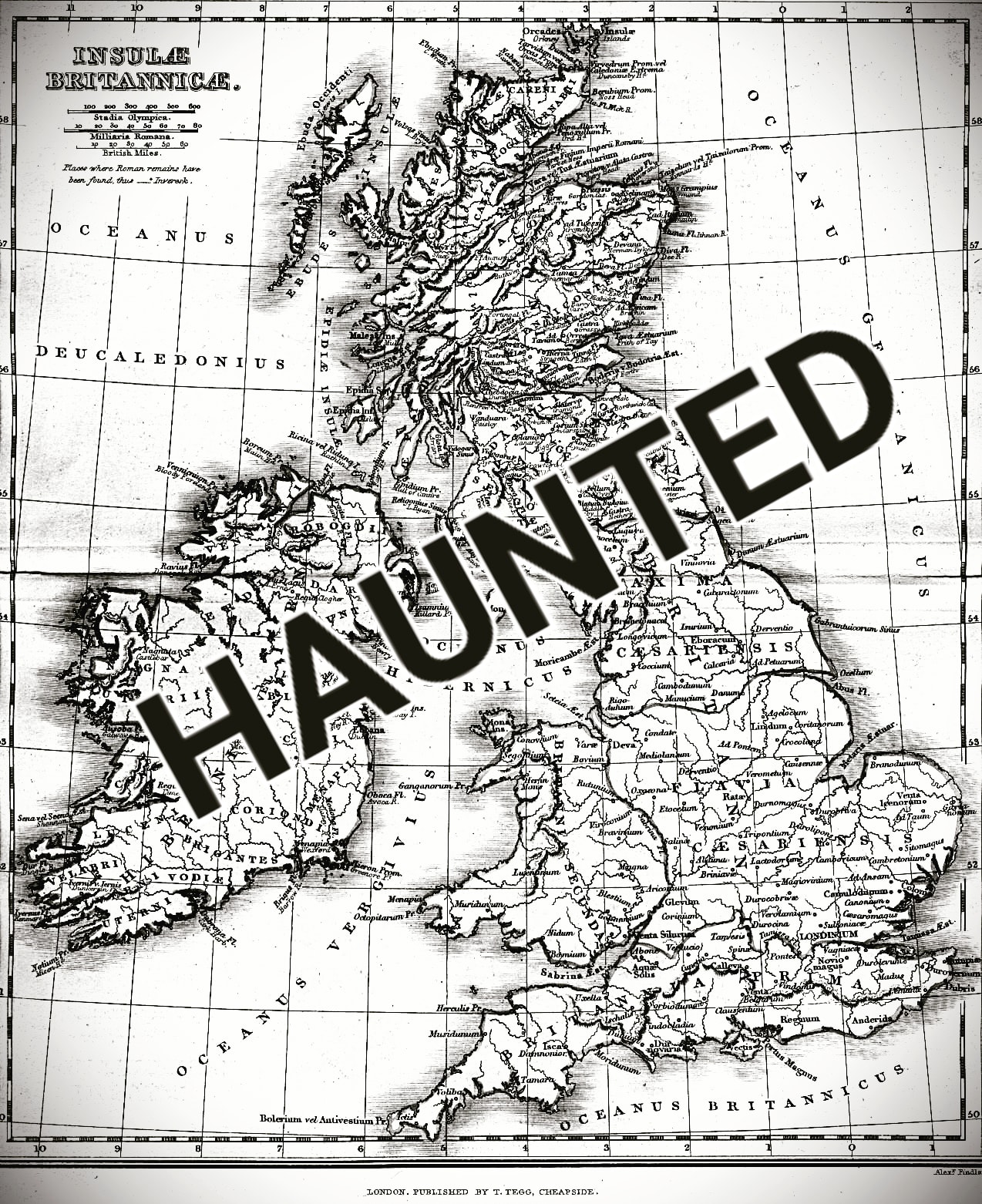

It’s that time of year again, the leaves are falling from the trees, the nights are drawing in, and coffee shops are pungent with pumpkin spice. Halloween is here!
What better time to take a swift tour around these haunted islands. Join us at the Haunted Palace Blog as we select 13 of our favourite spooky tales from Scotland, England, Wales, and Northern Ireland.
Scotland

The Mackenzie Poltergeist, Greyfriars Kirkyard, Edinburgh
Back in 1999, Greyfriars Kirkyard was mainly known as the last resting place of the Great and the Good, rather than a hotbed of paranormal activity.
Things changed one night, when a homeless man, seeking shelter from the rain, broke into the Mackenzie Mausoleum. With only the flame from his cigarette lighter, he explored the pitch-black interior. He soon came across the coffin of Mackenzie himself. Hopeful of finding something valuable, he approached the coffin. Unfortunately for him, he tripped and fell. He landed in a plague pit. His lighter flicked off. Finding himself plunged into darkness, lying in a pit of mouldering bones, he fled. Exiting the Mausoleum, screaming at the top of his lungs, he promptly crashed into a man walking his dog, both fled in terror.

Following these events, reports of paranormal activity in the graveyard spiked, visitors claimed to have been pushed and shoved, scratched, felt nauseous, and even fainted. The Mackenzie Poltergeist had been unleashed. But who, or what, was it?
Many people believe that the poltergeist is the residual energy of Lord George Mackenzie, Lord Advocate of Scotland during the seventeenth century. Mackenzie had a fearsome reputation that earned him the nickname ‘Bluidy’ or ‘bloody’ Mackenzie.
In the seventeenth century, Charles II wanted to impose his style of religion on the Scots, this resulted in the bitter Covenanters War in Scotland. Covenanters died, rather than submit to the Crown, battles were fought between the government and the Covenanters. After one such battle, Mackenzie had1200 defeated Covenanters imprisoned in the open air, within the Kirkyard. Conditions were inhuman, especially as the winter approached. Barely a handful survived this incarceration. When Mackenzie died in 1691, he was interred in the Mackenzie Mausoleum, a stones throw from the infamous Covenanters Prison that he created.
Perhaps the dormant energies of tormentor and tormented, lying in such close proximity for so long, were activated by the desecration of the Mackenzie Mausoleum on that fateful night at the tail end of the last century.
https://hauntedpalaceblog.com/tag/bloody-mackenzie/
Phantom Highlanders, Culloden Battlefield, Inverness
Anyone visiting the bleak and often rainswept Drumossie Moor, a few miles outside Inverness, will be struck by the wild and desolate beauty of the place. Some may also feel a lingering sense of sadness and loss, yet others claim to feel, or even see, a lot more. This is because Drumossie Moor is better known as Culloden Moor, the site of the last battle on the British mainland. Here the spirits of the dead do not lie quiet under the heather.
It was here on 16 April 1746 that Charles Edward Stuart, Bonnie Prince Charlie, led out his Jacobite forces, primarily made up of highlanders, and faced the might of Government forces, led by The Duke of Cumberland.
The battle was short and vicious, lasting barely an hour and the blood of the Jacobite’s soon dyed the field red.

Around 1500-2000 Jacobites were killed or wounded, and many died in the battle’s aftermath. Cumberland’s ruthless brutality following the battle earned him the nickname ‘butcher’.
The ghost of a wounded highlander has been seen, lying beneath bloodied tartan on one of the clan gravemounds that litter the battlefield.
It is also said that on the anniversary of the battle, the dead rise from their graves to fight again, and sounds of battle can be heard raging across the moor.
English/Scottish Borders
The Knight of Liddlesdale, Hermitage Castle, Liddlesdale Valley
In the turbulent borderlands between England and Scotland, sits the dramatic Hermitage Castle. Rising out of the boggy earth, the castle is infamous for many ghosts, including that of Mary Queen of Scots who is said to appear as a white lady.
One gruesome story may have influenced George RR Martin, in his Song of Ice and Fire series.
The story is of a deadly rivalry between Sir William Douglas and Sir Alexander Ramsey of Dalhousie. When Ramsey was made sheriff instead of Douglas, Douglas plotted his revenge. He ambushed Douglas as he was returning from church and had him imprisoned in the dungeons of Hermitage Castle.

Ramsey’s fate was to be slowly starved to death, only sustained by a few grains of wheat falling from the granary room above him. When his death was discovered, his corpse was emaciated, and his fingers had been gnawed down to the bone.
Many years later, when a skeleton was found walled up in the castle, with a rusty sword and a handful of chaff beside it, it was rumoured to be the remains of the unfortunate Ramsay.
Sir Alexander Ramsay is said to walk within the castle still, and his anguished cries sometimes reverberate off the moss-covered walls.
England

The Haunting of Willington Mill House, Willington Gut, North Tyneside
Willington Mill House was the site of a long-running poltergeist infestation that caused a sensation in the nineteenth century.
The Mill House was built at the beginning of the nineteenth century. In the 1830s, Joseph Proctor, his wife, and young family moved in.
The Proctors lived quietly for a time, but within a few years, began to experience strange noises coming from an unused room on the top floor. Ominously the windows, doors, and fireplace of the room had been boarded up when they moved into the house. Once the room was opened, events began to rapidly escalate.

The family suffered a range of phenomena that lasted for many years. They heard banging and footsteps in the upper rooms, heard disembodied voices close at hand, watched doors opening and closing of their own accord. Soon, they even began to see full apparitions, and even strange animals, including a phantom monkey. The family searched for rational explanations but found none.
Investigations were carried out, including one of the first recorded instances of a ghost vigil, which resulted in one of the participants being carried out in a dead faint, having claimed to see the terrifying apparition of an old lady coming towards him. Famous ghost enthusiasts, including WT Stead and Catherine Crowe all wrote about the case.
To this day, it remains one of the best recorded examples of a Poltergeist case, thanks to the journal kept by Joseph Proctor.
Thomas Skelton, the murderous jester, Muncaster Castle, Cumbria
In Cumbria, the ghost of a murderous Jester is said to wander the halls of Muncaster Castle near Ravenglass.
Thomas Skelton lived in the seventeenth century. He was jester to the Pennington family of Muncaster Castle, entertaining them with a mixture of practical jokes and wit. By all accounts, he was a well-loved family servant.

But legend says Thomas had a very dark side. One tale says that the beautiful daughter of the castle fell in love with a lowly carpenter. The affair was discovered by a rival suitor. The rival employed Skelton to waylay and murder the unfortunate carpenter, chopping off his head with an axe.
The murderous jester’s spirit is restless. Witnesses have reported hearing a heavy tread on the castle staircase, and the sound of a body (the unfortunate carpenter?) being dragged along behind them.
The Brown Lady, Raynham Hall, Norfolk
In 1936 the photographer Captain Hubert C. Provand and his assistant Indre Shira were taking photographs for Country Life magazine when they managed to capture one of the most iconic ghost photographs of all time, The Brown Lady of Raynham Hall. But this was not her first outing.

One hundred years earlier, at a Christmas Party held at the hall, some of the revellers noticed a woman wearing an old-fashioned brown dress, standing in a doorway. Suddenly she disappeared into thin air.
There were several more encounters, but the most dramatic happened in 1836. Frederick Marryat, who had heard of the ghost, but was a sceptic, was staying at Raynham for a hunting party.
He and two friends were walking down a dark corridor one night when they saw a melancholy woman carrying a light approaching them. Chillingly Maryat recognised her from a portrait in his bedroom, an old portrait.
As this was a hunting party, Maryat was carrying a gun, so he decided to confront her and demand an explanation for her presence. Before he could do so, the apparition stopped right in front of him. She turned to face him and “grinned in a malicious and diabolical manner”. Marryat, his finger on the trigger, fired, and the woman vanished. The bullet lodged in the door opposite. A shaken Marryat, no longer a sceptic, never tried to challenge the Brown Lady again.
The Haunting of Rectory Lane, Datchworth, Hertfordshire
The village of Datchworth holds the dubious honour of being the most haunted place in the county of Hertfordshire.
Its saddest haunting involves a horseless cart, which has been witnessed creaking its way up from the Village Green, along Rectory Lane towards All Saints Church. Many say they have seen lifeless limbs hanging over the edge of the cart. Some say that the cart moved silently whilst others that they heard bells leading some to speculate that the vehicle was transporting plague victims to the cemetery. In fact, this particular haunting has its origins in a desperate tragedy that occurred in the eighteenth century.

In 1768, Datchworth suffered a crop failure, pushing many families into poverty. The Eaves family suffered more than most and were forced to turn to the parish for assistance. In 1769, a shepherd boy entered the hovel that functioned as the village poorhouse. He found the skeletal remains of two adults, a young boy, and a female infant. The sole survivor, an eleven-year-old boy, was so traumatized that he ended his days in an asylum.
The true horror lies, not in the gruesome discovery, but in the fact their neighbours shunned the suffering family and allowed them to slowly starve to death without trying to help them.
Efforts were made to cover up the tragedy, but the story soon became a public scandal thanks to a local philanthropist and eccentric who published a pamphlet damning the system that allowed such neglect to occur.
The Black Nun, The Bank of England, London
One of London’s many ghosts is that of Sarah Whitehead, otherwise known as the Black Nun. Sarah’s tragic tale begins in 1811 when her brother, Philip, a former clerk in the Bank of England was found guilty of forgery and fraud. On the day of his trial, Sarah’s friends kept the news of his conviction from her but when her brother failed to return home, Sarah went to find him, she would never stop searching.
She became a common sight at the Bank of England, where she repeatedly demanded news of her brother. A clerk finally told her of his fate, news which destroyed her mind.

Sarah donned a black dress and covered her face with a long black veil, dressing like this for the rest of her life. When she died, she was buried close to the bank where her brother had worked.
Since then, Sarah’s ghost has been seen at the Bank of England itself, at Bank station and in the former graveyard of the church where she was originally buried. Those witnesses who have seen her have said that she walks hesitantly, groping her way along as if she is blind then she falls to her knees and beats the ground with her fists, crying and shaking violently before she suddenly vanishes.
She has been most often seen at night wandering near the bank and in Threadneedle Street. Witnesses have reported they are overcome by a feeling of intense grief and loneliness. Some brave souls have approached her to ask her if she needs help. Needless to say, she just turns and asks her constant question, ‘Have you seen my brother?’
The Drowned Lady, Chambercombe Manor, Devon
Chambercombe Manor has many ghosts, but the most interesting tale began with some roof renovations carried out in 1865, The tenant and his wife had noticed a window that they could not account for. Investigating they found a hidden room containing a grisly secret. Amidst the dust and cobwebs they found a four-poster bed, and upon the bed lay the skeletal remains of a woman.

Local legend says the woman may have been the victim of Wreckers, eighteenth-century criminals who plied the coast of Devon and Cornwall drawing ships to their destruction on the rocks. She survived the wreck but was badly injured and she was taken to Chambercombe to recover. Sadly, she died. However, as she was wealthy, her rescuers, who may have been connected to the wreckers, decided to keep her riches and hide her body in a bricked-up chamber.
To this day, there have been reports of low moaning, and the sound of footsteps heard emanating from the hidden chamber.
Wales

The Ghost of Henry Marten, Chepstow Castle, Monmouthshire
Chepstow castle boasts the ghost of a seventeenth-century Roundhead lawyer who met a grisly fate.
The conclusion of the English Civil War came when King Charles I was beheaded in 1649. The King’s death warrant was signed by 59 Commissioners. Henry Marten was one of them. When the monarchy was restored in 1660, King Charles II sought revenge against his father’s killers.
Marten was imprisoned in Chepstow Castle until his trial. Tried in London in 1662, he suffered that most gruesome of judicial punishments, he was hung, drawn, and quartered.
His troubled spirit is said to linger in Chepstow Castle, and for the past century, there have been reports of doors mysteriously slamming shut, disembodied footsteps, and glimpses of his ghost, lurking in his prison cell, doomed to await his fate for all eternity.
The Green Lady, Caerphilly Castle, Caerphilly
Caerphilly Castle was built in the thirteenth century by Gilbert de Clare and a tragic love story is built into its very stones.
Gilbert’s marriage was not a happy one. His wife, the lovely Princess Alice of Angouleme was in love with another man, Gruffudd the Fair, Prince of Brithdir. Alice and Gruffudd became lovers, but a treacherous monk betrayed them to Gilbert.

Alice was packed off back to France, while Gilbert set out to hunt down his rival. Gruffudd was captured and hanged by Gilbert (but not before he exacted his own revenge on the loose-lipped monk).
On hearing the news, Alice died of shock.
Legend has it her sorrowful spirit, in the form of a Green Lady, can be seen walking the ramparts of Caerphilly Castle, watching for her lost lover.
Northern Ireland

The Banshee, Dunluce Castle, County Antrim
Dunluce Castle, perched on a rugged coastal outcrop, is the site of another tale of thwarted love. In the sixteenth century, it was the seat of the MacQuillan Clan.
It was said that Lord MacQuillan had a beautiful daughter, Maeve Roe. MacQuillan wanted his daughter to marry the man of his choice, Richard Oge, but Maeve had other ideas. Her heart was set on the dashing Reginald O’Cahan.

Hoping to thwart any escape plans, MacQuillan had Maeve confined to the northeastern tower of the castle. Nevertheless, under the cover of darkness, Reginald came to carry off Maeve. The couple fled to a cave beneath the castle where a small boat was waiting to carry them to safety. Once out on the open water, however, fate had other plans. The night was stormy, and the waves were high, soon the little boat sank, leaving the lovers to drown in the inky black depths.
Maeve’s body was never found, but her tragic spirit made its way back to land transformed into a wailing banshee, trapped for eternity in her high prison tower, above the crashing waves.
Grey Lady, The Dark Hedges, County Antrim
The Dark Hedges were made internationally famous by the Game of Thrones TV series, where they doubled for The Kings Road.
The avenue of beech trees was planted in the eighteenth century by the Stuart Family. It forms a leafy and undeniably gothic approach to their rather plain Georgian house.
It is said to be the haunt of The Grey Lady, whose shadowy form has been seen flitting amongst the trees at dusk. Her origin is unknown, some say she is the ghost of an unhappy maid, others say she is the ghost of Margaret Stuart, known as ‘Cross Peggy’, or she could simply be a lost soul from an abandoned graveyard.
It is also said that every year, on 31 October, all the nearby graves open and release their inhabitants. On that night, the Grey Lady does not walk alone – dare you join her?

So, there we have it, poltergeists, banshees, spectral ladies of many hues, murderers and murder victims, thwarted lovers and tragic deaths, these are just a few of the haunting tales from the rich ghost lore of the British Isles.
But what is your favourite ghost story? Let us know in the comments.
Happy Halloween

Other sources
Culloden Battlefield, https://spookyscotland.net/haunted-culloden/#SnippetTab
The Ghost of Henry Marten, Chepstow Castle,
The Green Lady of Caerphilly Castle, https://great-castles.com/caerphillyghost.html
The Banshee of Dunluce Castle, https://emeraldisle.ie/the-haunting-of-dunluce
The Grey Lady of the Dark Hedges, https://www.visitcausewaycoastandglens.com/blog/read/2023/10/haunted-locations-to-explore-in-the-causeway-coast-and-glens-this-halloween-b198
© Haunted Palace



Leave a Reply