
Lady’s Tower

On a low cliff on the rugged headland of Ruby Bay in Fife, Scotland, stands a lone tower. Roofless and empty, the coastal winds whip through its circular interior, gulls screech at its empty windows, while the sea beneath roils against the rocks and hisses on the sand of the beach below. It is the epitome of a romantic ruin, capturing the very essence of the early Gothic revival. Despite this, the structure was no mere decorative folly. Inside there is evidence of a fireplace in the north wall, which hints at comfort. Three vast arched windows command spectacular views along the bay, indicating an appreciation of the seascape beyond. This was a building designed to be used and enjoyed. It is also emblematic of shifting attitudes to both the sea and to health in eighteenth century Scotland and England.
Lady’s Tower was built at some point between 1760 and 17701 for Lady Janet ‘Jenny’ Anstruther (1725-1802), wife of John Anstruther (1718-1799) the notoriously truculent 2nd Baronet, an industrialist and MP for the Anstruther Burgh.
Jenny caused quite a stir on her entry into Fife society. She was famously described by Thomas Carlisle as ‘a coquette and a beauty’2 The portrait painted by Sir Joshua Reynolds in 1761, shows an attractive dark haired, dark eyed woman. This type of fashionable portrait follows a set of conventions and is replicated in country houses and art galleries across the UK. It embodies a standard ideal of demure, classical, feminine beauty favoured in the eighteenth century. Jenny seemed born to break that mould.

Queen of the Gipsies
Janet was born in 1725, into the Fall family. Her father, Captain James Fall (pronounced Faa) was a successful Dunbar businessman and MP for Haddington Burgh. The Falls were an interesting family and claimed descent from the legendary Gipsy royal family of Faa.3 Some sources say Jenny embraced her supposed gipsy heritage and referred to herself as ‘Queen of the Gipsies’ when it suited her. Yet other sources report that during her husband’s electioneering campaign, a particularly fractious mob derisively sang ‘The Gipsy Laddy’ at ‘Jenny Faa,’ much to Lady Anstruther’s displeasure.4,5
Historically, gipsies have often had to walk a fine line between being exoticized and being shunned and discriminated against. Well into the eighteenth century in Scotland it was perfectly legal to hang someone for being a gipsy.6 Perhaps the context mattered to Jenny, if she was proud of her family’s supposed links to the Faa’s, then perhaps it was obvious to her when the term was being used as a slur.
The truth of her origins may be far more mundane, the Falls were highly successful merchants in the Fife area in the eighteenth century. As unashamed nouveau riche, they may simply have rubbed the region’s ‘Old Money’ up the wrong way, leading to snide remarks about their dubious origins. When coupled with Jenny’s beauty, strong personality, and eccentric habits, this may have made her a natural target for local gossip. Perhaps she was happy enough to sometimes lean into the idea of being gipsy royalty as a way of getting one over on those who disliked her by showing that their barbs did not hurt her.
In any event, sadly, there is no concrete evidence linking the stolid merchant family of Fall to the legendary Gipsy royal family of Faa. 7,8
A curse on the Anstruthers

What turbulent gipsy beauty would be complete without a curse? Part of Jenny’s legend includes the tale that she brought a curse upon the Anstruther family. This piece of local lore begins with the building of Elie House, home of Jenny and her husband.
Elie House is located in the village of Elie in Fife; it was built in 1697 by Sir William Anstruther and became the ancestral seat of the family. When Janet married Sir John Anstruther in 1750, they took up residence at Elie House. Being young, wealthy, and fashionable, they undertook extensive work to update the house by adding a classical veneer to the earlier structure. The exact date for the renovations is uncertain, but it appears to have occurred sometime between 1760 and 1770.9 Part of this project included extensive landscaping of the grounds along with building a ‘summerhouse.’ It is this building that would later become known as Lady’s Tower.
A popular piece of local lore says that during these renovations, Janet complained to her husband that her view from Elie House to Loch Kilconquhar was disrupted by the village of Balclevie, a collection of seven or eight rustic hovels.10
To Jenny, the solution was simple – remove this blot on the landscape and to hell with the inhabitants. This was not such an uncommon approach at the time. Many Georgian landowners, bent on improving their estates in line with the fashion for wide sweeping vistas introduced by gardeners such as Capability Brown, chose to demolish or relocate inconvenient villages, riding rough shod over their tenants.
This imperious plan did not go down well with the inhabitants of Balclevie. Lord Anstruther owned most of the cottages at Balclevie, so was perfectly within his rights to demolish the buildings, or at least, most of them. At least two of the houses had been gifted by the Anstruthers to former servants and were privately owned.11 Local legend has it that an old lady (a tenant, or maybe an owner occupier) was so incensed with the high-handed actions of Jenny that she laid a curse upon the Anstruther family, declaring that they would remain only six generations at Elie House. 12,13

This curse was set in verse by the Rev R. A. Armstrong of Kilconquhar:
Balclevie was a village fair, Balclevie is no longer there,
They took and cast its houses down, Balclevie was a bonnie town.
She cursed the tongue that gave command that not one stone be left to stand.
She cursed the Lady Jenny Fa’ that their wee toon had taken awa.’14
Of course, as with any good curse, given enough time, it proved to be true. The cash-strapped sixth generation of Anstruther’s sold Elie House to the Baird family in 1853.
But was Jenny to blame for the destruction of Balclevie? Ultimately, because of the power structures of the eighteenth century, it would be far more likely Lord Anstruther who signed off on the demolition. He was also known to be a rather difficult gentleman in his own right. However, Jenny may well have been the driving force behind this project and the local wags certainly thought she wore the breeches in her marriage, claiming that thanks to her, Sir John was ‘the best drilled man in Fife.’ 15
In any case, the poem was penned a long time after events, and may simply have been a colourful way to explain the declining fortunes of the family over time.
Whatever the truth, the curse certainly took an awfully long time to take effect!
Scandalous Skinny dipping

During Jenny’s reign at Elie, she had a summer house constructed, now known as Lady’s Tower. The tower stands at Saucher Point on Ruby Bay, a few miles from Elie House.
This structure is associated with the most memorable folklore associated with Jenny, that of her skinny dipping in the bay.
The tale goes that Jenny liked to swim daily in the sea and did so in the nude. She would head over from Elie House to a beachside cave carved out of the cliffs and strip off for her bracing swim in the icy waters of the bay. To protect her modesty and prevent any curious villagers from spying on her while she enjoyed her dip, servants would ring a bell, which was intended to warn people to stay away. One can only imagine whether alerting people to the fact that the famous local beauty was skinny dipping nearby, would fulfil its intended purpose or have the exact opposite effect!
After her bracing swim, she would retire to Lady’s Tower, with a cosy fire, comfortable furnishings, and beautiful views across the bay, to relax and recover from her exertions.
So, how true is the tale, did the beautiful Lady Anstruther really skinny dip in the icy waters of sea? And why was this story shocking at the time?
To understand why sea-bathing was considered such an unusual activity for a lady (or anyone, for that matter), we need to consider how attitudes to health changed over the eighteenth century.

The sea washes away all the ills of mankind [Dr Russell]
For many hundreds of years, the sea was a place of fear and dread. A treacherous and dangerous element to be endured only if absolutely necessary.
This began to change in the eighteenth century. As early as 1701, Sir John Floyer, proposed cold bathing to cure lameness, consumption, palsy, and strangest of all, to avoid effeminacy! His rationale for this last claim was that cold bathing led to the Romans being ‘very, very manly men’ and absolutely not effeminate at all (perhaps nobody mentioned Nero to him?)
In 1747, Methodist Preacher John Wesley promoted cold bathing, making the dramatic claims that, among other things, it could cure blindness. By 1750, Dr Richard Russell made the case for sea bathing in his snappily titled and influential book Dissertation on the use of Sea Water in Diseases of the Glands. (In Latin, of course). Other medical men followed. Sea bathing was the new snake oil, a cure for all ills.
This emphasis on sea bathing as a health-giving cure ran in parallel to a change in aesthetic sensibilities galvanized by the publication in 1756 of Edmund Burke’s seminal Romantic text Origin of our Ideas of the Sublime and Beautiful. This book helped reshape people’s ideas of what was deemed beautiful or horrible, allowing that beauty could be found in the dark, awesome and terrible aspects of nature. The sea was becoming fashionable.

Understanding this sea-change (pardon the pun) in attitudes to the sea both medically and aesthetically, shows that Jenny was far from being a lone eccentric ploughing up and down the seashore, but was in fact influenced by cutting edge, fashionable new ideas. At this time resorts like Brighton and Weymouth were starting to become popular, with sea-bathing on the itinerary for many visitors. Many popular writers, such as Henry Smollett, were also banging the drum for the health benefits of regularly dipping oneself in the briny.16
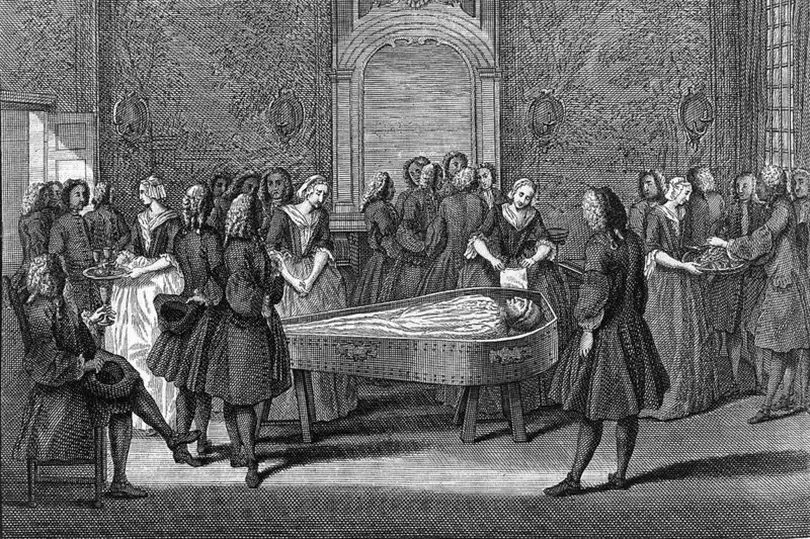
As a glittering member of local Fife society Jenny may have bathed naked, or she may have chosen to wear one of the new bathing gowns that were becoming available (see image above). Whatever she chose, she undressed privately in a specially prepared cave on the seashore, well out of sight. Whether she actually swam or simply immersed herself in sea water, is not clear. But as she lived to the ripe old age of seventy-seven, whatever she did, it seems to have agreed with her.
Jenny was not the only fan of cold-water bathing in Fife, her husband, the prickly MP and merchant Sir John, had a public cold bathing pool constructed for free use by the local population.
On 3 March 1773, The Caledonian Mercury reported on his venture:
‘Cold bathing is to be had at Dunbar in the greatest perfection, as there has been lately erected a most noble bath for that end, and the use of which is generously afforded to the public, gratis, by the proprietor of it.‘
While Jenny’s bathing spot was purely private and she did not use the public baths, it would be interesting to know whether she braved a buffeting in the waves of the open sea or entered the water via some specially constructed tide filled bathing pond, secluded from the public gaze. Sadly, I have not had the chance to visit Lady Tower or Ruby Bay, so I do not know if this is the case, but if any one does know, please let me know in the comments.

Conclusion
Jenny caused a stir in local society, she was beautiful, flirtatious, and haughty and, perhaps, a little callous. She had new ideas about architecture, landscaping and health. She was new money in an old money world. While her husband was known to be a difficult man, she seems to have managed him well. In short, through the lense of time, she appears to be a strong-willed woman who knew her own mind, good qualities in the twenty first century. However, in the society she inhabited, over 250 years ago, she was perceived by some as a brash Johnny come lately, a high handed nouveau riche, riding rough shod over the poor and behaving in a scandalous manner. No wonder so many extraordinary tales swirled about this remarkable woman.
Lady’s Tower fell into ruin in the nineteenth century but is now experiencing a revival as a popular backdrop for wedding photos.
Postscript
While curses are two a penny as far as old families go, it is interesting to note that Elie House still attracts strange happenings. In the research for this post, I reached out to Graham Johnston of the Elie and Earls ferry History Society. He explained that in recent years Elie House had fallen into disrepair, but by the early 2000s a developer was renovating the old house and converting it into apartments. A string of bad luck bedevilled the renovations, lead was stolen from the roof, the developer went bust, there was an outbreak of dry rot, a nightwatchman fell down a manhole and injured himself, the sewage system went haywire, and a resident had all of their furnishing stolen just before they moved in. Talk of the curse resurfaced, and eventually, some of the residents decided to take a picture of Elie House along to a priest to have the house blessed by proxy.16
But I wonder, if not the curse, perhaps the strange happenings are down to the spirit of Jenny herself, overseeing the renovation of her old home across the centuries. There are more things in heaven and earth…

With Thanks
With thanks and gratitude to Graham Johnston of the Elie and Earlsferry History Society for kindly sharing additional information about Jenny Fall and her family with me, and for giving permission to share his fascinating anecdotes about strange goings on at Elie House.
Notes
- Nicholas Kingsley, (151) Carmichael-Anstruther of Elie House and Carmichael House, baronets
- Graham Johnston, POTTED HISTORY No 4: Elie House – Part 1&2
- A. Francis Stewart, A, The Falls of Dunbar, and Their Descent from the Gypsies
- ibid
- Graham Johnston, POTTED HISTORY No 4: Elie House – Part 1&2
- Shamus McPhee, The persecution of Gypsy Travellers in Scotland – a timeline
- Graham Johnston, POTTED HISTORY No 4: Elie House – Part 1&2
- A. Francis Stewart, A, The Falls of Dunbar, and Their Descent from the Gypsies
- Graham Johnston, POTTED HISTORY No 4: Elie House – Part 1&2
- Graham Johnston, email to Lenora
- ibid
- Nicholas Kingsley, (151) Carmichael-Anstruther of Elie House and Carmichael House, baronets
- Graham Johnston, POTTED HISTORY No 4: Elie House – Part 1&2
- ibid
- Graham Johnston, email to Lenora
- Katherine Ashenburg, Clean, An Unsanitised History of Washing
- Graham Johnston, email to Lenora
Bibliography
Ashenburg, Katherine, 2008, Clean, An Unsanitised History of Washing
British Newspaper Archive, Leven Mail 11/8/1954 Bathing Place Hewn out of Rocks,
British Newspaper Archive, Edinburgh Evening News 25/4/1925, The Lady’s Tower
British Newspaper Archive, Poustie, William, The Lady’s Tower: An Elie Romance in East of Fife Record 4/1/1907
Elie and Earlsferry History Society, 9/2/2024, Walking Tour 3 Elie Harbour,
https://www.eliehistory.com/history-walks/walking-tour-3-elie-harbour/
Francis Steuart, A, The Falls of Dunbar, and Their Descent from the Gypsies, in The Scottish Antiquary or Northern Notes and Queries, Vol 16, No 63, Jan 1902, p127-132
Johnston, Graham, Email to Lenora, 5/12/2023
Johnston, Graham, 26/1/2024, POTTED HISTORY No 4: Elie House – Part 1 and 2 https://www.eliehistory.com/people-and-places/history-elie-house-part-1/ and
https://www.eliehistory.com/people-and-places/history-elie-house-part-2/
Kingsley, Nicholas, 28/12/2014, (151) Carmichael-Anstruther of Elie House and Carmichael House, baronets,
https://landedfamilies.blogspot.com/2014/12/151-carmichael-anstruther-of-elie-house.html
McPhee, Shamus, 23/6/2023, The persecution of Gypsy Travellers in Scotland – a timeline
https://blog.historicenvironment.scot/2023/06/persecution-of-gypsy-travellers-in-scotland/

Leave a Reply