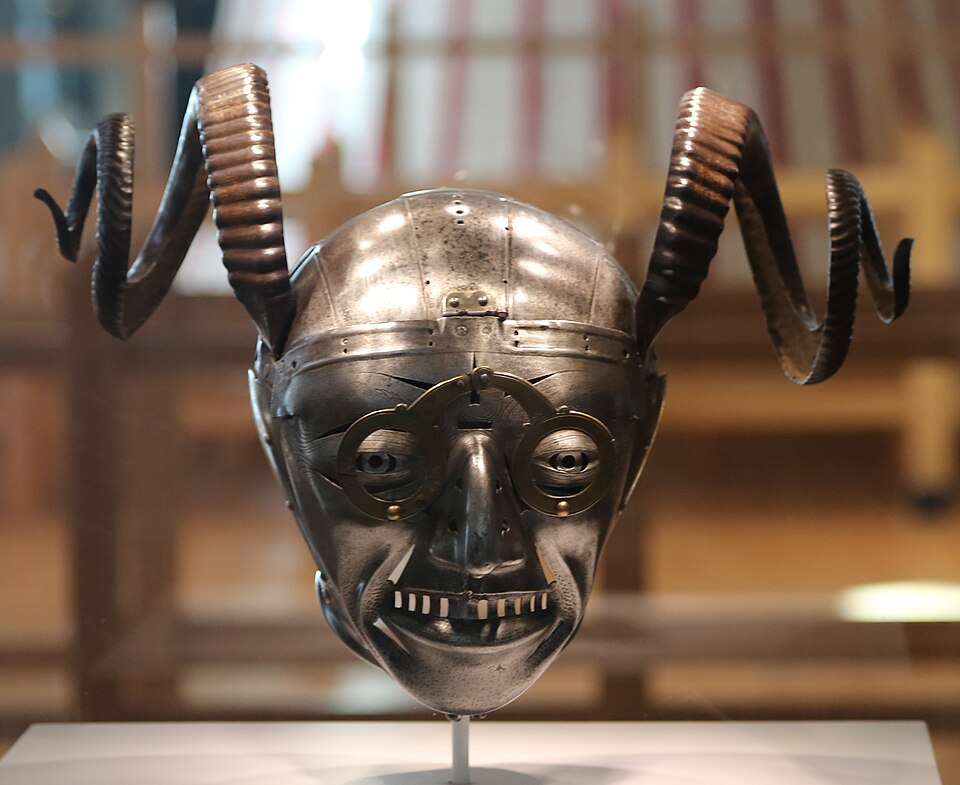
Walk through the display rooms of the Royal Armouries in Leeds and you are bound to come across a very unusual object. For many people, it’s the highlight of their visit, and for some it’s the main reason for their visit. For others, well, it stops them in their tracks, fascinated by its ghastly visage and creepy, mocking smile. However, it’s not only casual visitors who the object seems to cast a spell over, but also historians. Over the years, many historians and armour enthusiasts have tried to unravel the mystery of Henry VIII’s horned helmet.

Steve F, CC BY-SA 2.0 <https://creativecommons.org/licenses/by-sa/2.0>, via Wikimedia Commons
A Gift from an Emperor
The helmet, the only surviving part of a full set of armour, was gifted to Henry VIII by Maximilian I, the Holy Roman Emperor, sometime between 1511 and 1514. The rest of the armour is thought to have been scrapped around 1649, after the English Civil War1. The reason for scrapping the armour, along with many other pieces, was probably simply financial. The Civil War had drained the coffers, and high taxes had left England in severe debt and financial distress. The armour may have been an easy way of raising some quick money. If so, we are very lucky the helmet survived.
The armour’s quality probably made it worth quite a bit. This makes sense. If it was a diplomatic gift to strengthen the ties between the two powerful rulers, then it had to be good. It’s believed that Maximilian commissioned the armour from Konrad Seusenhofer2. Seusenhofer, who was based at Maximilian’s Imperial armoury in Innsbruck, Austria, was one of, if not the, leading artisans of the time and a favourite amongst the nobility and royalty of Europe. His creations included the stunning Boy’s Armour and barding (horse armour) of Charles V3.

Although it is usually referred to as a helmet, it’s more accurately described as an armet. Armets were a type of helmet that fully enclosed the face, head and neck, providing the wearer with both protection during battle and ease of movement. They became popular during the fifteenth century, with men-at-arms and those wearing full body armour. The armet typically comprised 4 parts: a visor, the skull and 2 hinged cheek pieces4. However, it’s very unlikely that the Horned Helmet was ever intended for the battlefield. This isn’t only because it was made of expensive materials, including copper alloy, leather, ferrous metal, silver and then gilded5, but also because of how it looked. With its stubbly chin, toothy grin, protruding eyes, crow’s feet, a drip coming from the nose and brass spectacles bolted over the eyes, it wouldn’t have been suitable for combat (as it probably would have terrified the enemy, confused them, or caused them to collapse in laughter). Instead, it was probably designed as a grotesque helmet and armour for Henry to wear in parades6. Helmets with exaggerated human and animal features were very popular and commonly worn in parades during this period.

Some of the strangest theories about why Maximilian gave Henry the helmet include that the helmet was based on Maximilian or that it was supposed to mock Henry’s foolishness and lack of foresight (indicated by the missing glass in the spectacles)7. Neither of these theories makes sense, although it’s more than likely that it was sent to amuse Henry. At the time, Henry was in his early 20s and a very different person from the man he later became. From accounts, he seemed to have been fun-loving and taken himself a lot less seriously. However, it’s still highly doubtful that Maximilian would have wanted to mock either Henry or himself. I mean, why would Maximilian, one of the most powerful rulers of his time and who, if not handsome, was considered physically attractive, want to portray himself this way? And what would be the point of insulting Henry? What would he gain from it? Especially at this time, when they were on friendly terms and allied against the French during the War of the League of Cambrai.
Another theory sometimes bandied about is that it was never intended as a present for Henry but instead meant for Henry’s favourite fool, Will Somers. Will Somers was one of the only people who managed to remain close to Henry and survive his reign – a remarkable achievement. However, this theory doesn’t hold up because Somers entered Henry’s service at least a decade after the helmet was given (although the earliest written evidence for Somers’ presence at court is 1535). This doesn’t rule out the helmet having been a gift for another of Henry’s fools.
The Fool In Art
The helmet is clearly meant to represent a fool or jester. It bears an uncanny likeness to a few contemporary images. One of them is a playing card by the sixteenth-century artist Peter Flötner. The card shows a fool or jester who, like the helmet, wears spectacles and has a drip coming from his nose. The spectacle motif appears in two other distinct but very similar sixteenth-century paintings. These paintings are the Laughing Fool, usually attributed to the Amsterdam-based artist Jacob Cornelisz van Oostsanen and Portrait of a Madman Looking Through His Fingers by an unidentified Flemish artist. In both portraits, the male figure is shown holding spectacles and sporting a rather creepy, toothy grin8.

National museum of Swedem, CC0, via Wikimedia Commons
The Mystery of the Horns
So far so good. The smile, nose drip, and spectacles are obviously common motifs associated with fools and jesters, but that then leaves the question of the horns.
Let’s look at the evidence. The horns were well-made but crudely attached to the helmet, proving that they weren’t part of the original design. A horned helmet is mentioned in Henry’s inventory of 15479 and records found at the Tower of London show that about 100 years later, a horned helmet recorded as belonging to Somers went on display at the Tower10. This doesn’t necessarily mean it’s referring to the same helmet, but the odds are in its favour. So what does this tell us about Somers and Henry?
When Somers joined the Royal Court, he quickly became a favourite of Henry’s. Not so much with the royal courtiers, who never seemed quite sure what to make of Somers. Maybe they couldn’t shake off the feeling that Somers wasn’t quite as idiotic as he appeared or that they were the ones being played for fools by a master of fools.
Somers was very aware of the role he was expected to play and his image was an integral part of that. With his close-cropped hair, expensive green outfits and brightly coloured silk buttons (which he was famous for), he carefully moulded a unique look for himself.11Nothing was left to chance. That’s why it is highly likely that either Somers asked Henry for the helmet or Henry gifted it to him and gave him permission to add the horns. Henry was known to indulge Somers. I mean, what is more foolish-looking than a fool wearing a helmet with a grinning, toothy smile, bug eyes, spectacles, snot, and horns?
Out of all the theories, this is the one that makes the most sense. I mean, why would Henry have wanted a horned helmet? The helmet was a good festival mask, but the horns – they definitely carried connotations that wouldn’t have sat well with Henry.
On the positive side, horns were associated with traits that would have appealed to him. They were a symbol of virility, fertility, leadership, authority and strength and horned helmets were commonly depicted in stained glass windows and on crests.12
However, they also conjured up images that were less flattering and heroic. Horns were often used to represent the devil or the shame and humiliation of a cuckold. A cuckold was a man who had been cheated on by his wife. Since Henry had, according to his own beliefs, 2 wives who had been unfaithful, I doubt that this would have been something he wanted to remind himself and other people of. Henry wasn’t the self-deprecating sort.

British Library, CC0, via Wikimedia Commons
This leaves another question and I think the more interesting one: if this is what the horns represented, how did Somers get away with wearing the helmet? If we take the most innocent explanation, Somers simply thought the horns made him look silly and would amuse those around him, including the king.
However, Somers, despite his title, was no fool – he was probably the cleverest and wiliest person at court. So, it’s highly unlikely that he didn’t know the double-edged meaning of the horns. Maybe he used them to openly mock the morals of the royal court and the courtiers (that he might have secretly despised). Many of whom would have been cuckolds or even both the ‘cuckolder’ and ‘cuckoldee’.
The other explanation is that the horns were added to mock the one person who held his life in his hands – Henry himself. If so, Somers was playing a dangerous game. Maybe for him that was the appeal. Could he mock the king and live? Well, the answer was ‘yes’. If this is the reason for the horns, then maybe playing the fool was the most honest profession you could have at Court.

Notes:
- The Royal Armouries ↩︎
- Ibid ↩︎
- Dhwty ↩︎
- Armet ↩︎
- The Royal Armouries ↩︎
- David Goran, ↩︎
- Lorris Chevalier ↩︎
- Dhwty ↩︎
- The Royal Armouries ↩︎
- Paul Kendall ↩︎
- Will Somers ↩︎
- Oxford Historical Society ↩︎
Bibliography:
Chevalier, Lorris. (2025), A Medieval Cabinet of Curiosities
Kendall, Paul. (2021), Henry VIII in 100 Objects: The tyrant king who had six wives
Oxford Historical Society, (1893), Kidlington Church, Vol. 24
Andersson, Peter. Will Somer: Peter Andersson on Henry VIII’s Court Fool | Folger Shakespeare Library
Armet, Armet – Wikipedia
Dhwty (2020), The Perplexing Horned Helmet of Henry VIII | Ancient Origins
Goran, David. (2017), Henry VIII’s bizarre-looking horned helmet was designed for use in parades rather than for combat | The Vintage News
The Real Will Somers Under These Restless Skies: The Real Will Somers
The Royal Armouries, Armet – The Horned Helmet (IV.22) | Royal Armouries


Leave a Reply