If you delve into the myths and legends that have existed for centuries in the British Isles, you’ll often find stories of supernatural figures, who seem to bear a grudge against humans.

Perhaps, one of the most famous of these supernatural creatures are the enigmatic mermaids. Although, some mermaids were portrayed as benevolent, many were not. Tales of mermaids luring sailors to their death were told by storytellers in fishing villages. In other places, locals were taught to be wary of beautiful woman bathing in lakes, as they might find themselves trapped in a deadly embrace and dragged down to their watery grave. These stories support a theory that mermaids represented the seductive and dangerous traits of women. Another interpretation is that they are a personification of the sea, embodying its powerful, beautiful, and deadly nature. A reminder to sailors to take care, as things aren’t always what they seem – as jagged rocks may lurk beneath the calmest of waters.
This idea of the fey and other creatures being a warning to humans of the perils of nature can be found in many local areas. Often these tales were either used as a warning to frighten children and prevent them from wandering off such as the tales of the hyter spirits of Norfolk, hell-hounds-hyter-sprites-and-god-fearing-mermaids/ or as a reminder that certain places were dangerous, and people should be on their guard.
Simonside Dwarves
The Simonside Hills in Northumberland is an area known for its beauty; its rugged terrain, moors, and forests. It’s also said to be inhabited by the Simonside Dwarves, who delight in playing tricks on humans.

Often the dwarves are described as holding lights[i]. These lights are reminiscent of stories of Will-o’-the-wisps, who weary travellers, crossing moor and bogs, mistake for the lights of houses and follow to their misfortune. Other names for Will-o’-the-wisps include the bizarre and delightful: Hinky Punk, Peg-o-lantern, Kitty-candlestick, Hobbedy’s lantern, Joan the Wad, Pinket and Spunkies. However, unlike these ‘Will-o’-the-wisps’ who can sometimes be kind to humans, the Simonside Dwarves, were usually anything but. One well-known story is of a man who becoming lost in the hills was approached by a rather ugly little man who offered to lead him to safety. Feeling that something was not quite right, he refused the offer of help. The dwarf became angry and suddenly lights appeared all around them. Confused but aware of the danger he was in, the traveller decided to stay put and wait until the morning. His wise decision possibly saved his life.
Another tale tells of a man who got lost in the hills and in the darkness came across a small cabin. Relieved to have found shelter, he decided to stay the night. Exhausted, he fell into a deep sleep. On waking up, he was shocked to realise that the cabin had disappeared, and he was lying on the edge of a precipice. One small roll and he would have fallen to his death[ii]. This glamour or illusion was said to have been a common trick of the dwarves. A variation on this story tells of how a man found a hut on the moor in which he could see a dying fire, 2 stones and 2 gateposts. On entering, he sat down on one of the stones and added more wood to the fire. While he was sitting, a man, short of stature entered. This man seemed angry that the traveller was adding wood to the fire and broke one of the gate posts and threw it onto the fire. The traveller realised that his host was annoyed and decided to stay quiet. Somehow, he managed to sleep upright, which was lucky indeed, as when he woke, he was sitting on a stone on the edge of a steep drop[iii].

Published in Gjellerup, Karl (1895). Den ældre Eddas Gudesange. Photographed from a 2001 reprint by bloodofox via Wikimedia Commons.
One other story shows an even more unpleasant side to the dwarves. Two men from Newcastle decided to go hunting in the hills. While eating their lunch, they were approached by a short man dressed in brown. The man asked the hunters if they knew who he was. The younger of the men said yes and called him the ‘Lord of the Manor’ and offered him the carcasses of the birds they had shot. Their present was refused, on the grounds that the dwarf didn’t eat meat. However, he invited them to join him in a meal. Although the younger man was happy to accept, his companion refused and led his friend away. In Rothbury, they told a local landlord about their encounter. The landlord praised their good sense, stating that the man was one of the dwarves who dwelled in the hills and who would tempt strangers into their lairs and then kill and feast on them[iv].
Kelpies of Scotland
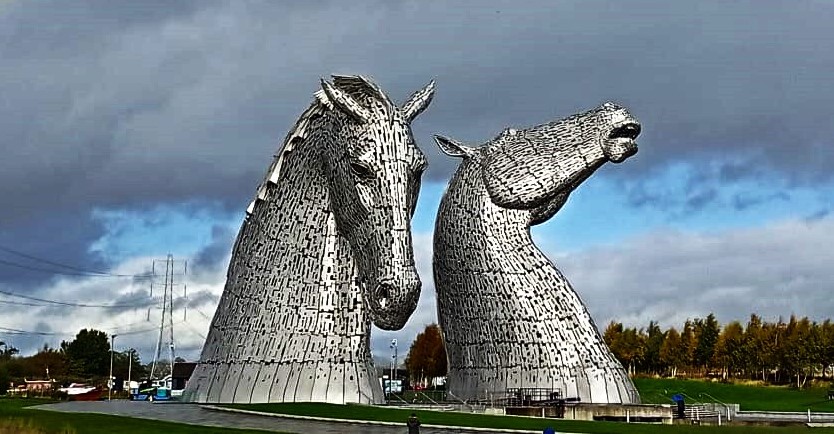
The shape-shifting water spirits of Scotland’s lochs and rivers were often used as a warning of the dangers of certain waterways. These spirits known as kelpies, a word that might have derived from the Gaelic words ‘calipeach’ or ‘colpach’ for colt, often manifested as a grey, black, or white horse-like creature[v]. (However, they could also appear as a beautiful young woman who would entice men into the water or a hairy human like figure lurking under the water ready to pounce on innocent travellers).
There are many stories attributed to the kelpies. One of the most famous of these kelpie encounters involves a group of children (the number of children varies from 8 to 10 depending on the version) who lived in the county of Sutherland in the Highlands of Scotland. The story goes as follows: one day the children decided to explore the nearby loch, ignoring their parents’ warnings. This loch was known to be the home of a kelpie, who dwelt within its deep waters. On reaching the loch, the kelpie emerged and one by one the fascinated children climbed onto its back and became stuck fast to its coat. However, one of the children, Dougal, who had only reached out to touch the kelpie, suddenly realised the danger they were in. He somehow managed to reach into his pocket, pull out a pocket knife and cut off his finger. Suddenly, the kelpie dived into the water, taking Dougal’s friends and his finger with it[vi].
This brings up one of the interesting traits of the kelpie – its sticky coat[vii]. The nature of its coat meant that anyone who unfortunately mounted the kelpie or even touched it, would be stuck fast and all hope would be lost. Another interesting feature of the kelpie legend is the rather unnerving idea that once a kelpie has set its sights on its victim – that person’s fate is sealed.

While working in a field near the River Conon, a group of men heard a strange voice come from the river. The voice gave a warning, ‘The hours has come but not the man’. They then saw a large black stallion rise up from the water and disappear. Frightened, the men decided it was best to stay clear of the river for the time being. However, a stranger came riding along and paying no heed to the men’s warning, tried to cross the river. The men grabbed the man and dragged him off his horse and into a nearby church. Standing guard they refused to let him leave. After an hour and thinking the danger was past, they entered the church, only to find the man dead. He had been drowned in a low water trough[viii]. It seems that the hour had come, and the unfortunate rider was the man.
The story of the curious children of Sutherland fits neatly into the idea that certain spirits, fey, and other supernatural entities were used as a warning to protect children from harm. What better way to prevent a child going to close to a dangerous waterway than scaring them with a story of a monster. As to the River Conan, the river crossing in this stretch of water was known as being treacherous and the scene of many a fatality, especially in winter[ix]. The story of the kelpie may simply have been a warning to take care as well as possibly an explanation for the number of deaths that occurred there.
So, when you go down to a river or loch in Scotland and you happen to see a rather magnificent horse standing in the water – take care it’s not a kelpie – and check its hooves. For a kelpie’s hooves unlike a normal horse’s hooves, face backwards. However, by the time you get that close, it may be too late!

The Grindylows
Another ‘bogeyman’ who was used as a scare tactic for children were the grindylows. The grindylows are evil water spirts who appear in Lancashire folklore. They were believed to inhabit ponds, marshes and rivers. Looking like ugly old women with long arms and fingers, pale brown or green skin, and sharp teeth and claws, they preyed on children. If a child came to close, they would jump up and drag the child into the water[x].
A variation of the grindylow, also found in Lancashire and bordering areas, is Jenny Greenteeth. Jenny Greenteeth is described as an old hag who would drown children and the elderly. As with the grindylow, she was said to have green skin and sharp teeth as well as long hair. Jenny Greenteeth is also a colloquial name for duckweed, a pondweed that forms a mat-like cover over water[xi]. Anyone, unaware of its nature, could step on it thinking it was a solid surface, only to find themselves tangled up and dragged under.
Although the grindylows and Jenny Greenteeth were specific to Lancashire, other areas in the UK also had their own variations of the evil water hag. These include Peg Powler of the River Tees[xii] and her sister or daughter, Nanny Powler of the River Skerne and Cheshire’s Nelly Long Arms.
There are many other tales of creatures throughout English, Scottish, Welsh and Irish folklore who either dwelt in lonesome places that you were best avoiding or who were used as a warning by parents to keep their children safe. Although, as with the story of the kelpie and the children, it does make you wonder, how effective these tales really were.

If you know of any other similar stories, please feel free to share in the comment section below.
[i] The Simonside Dwarfs
[ii] Ibid
[iii] Icy Sedgwick, Are the Simonside dwarfs like the miners of Middle Earth?[iv] Ibid
[v] Ben Johnson, The Kelpie
[vi] Graeme, Traditional Scottish Kelpie Legends – Folklore From Scotland
[vii] Ben Johnson, The Kelpie
[viii] Ibid
[ix] John Mackay Wilson, Wilson’s Tales of the Borders and of Scotland
[x] Icy Sedgwick, Strange River Folklore: River Gods and Dark Spirits
[xi] Jenny Greenteeth
[xii] Peg Powler
Bibliography
Icy Sedgwick, https://www.icysedgwick.com/river-folklore/
Jenny Greenteeth, Jenny Greenteeth – Wikipedia
Peg Powler, Peg Powler – Wikipedia
The Simonside Dwarfs, https://astonishinglegends.com/astonishing-legends/2019/10/16/the-simonside-dwarfs
Simonside Hills, https://www.northumberlandnationalpark.org.uk/places-to-visit/coquetdale/simonside-hills/
Icy Sedgwick, Are the Simonside dwarfs like the miners of Middle Earth? https://www.icysedgwick.com/simonside-dwarfs/
Ben Johnson, The Kelpie, https://www.historic-uk.com/CultureUK/The-Kelpie/ Historic UK
Graeme, Traditional Scottish Kelpie Legends – Folklore From Scotland, The https://scotlands-stories.com/scottish-kelpie-legends/
John Mackay Wilson, Wilson’s Tales of the Borders and or Scotland: Historical, traditional & imaginative, with a glossary, 1885
Margaret Evans, The Kelpie – Mythological Water Horse of Scotland, https://www.horsejournals.com/popular/history-heritage/kelpie-mythological-water-horse-scotland



Leave a Reply