
Napoleon and Egyptomania

On 1 July 1798, Napoleon invaded Egypt. As well as his army, he also brought an entourage of around 150 savants, scholars and scientists, whose job it was to record, collect and study Egypt and its vast history. The result of that extensive study was the lavishly illustrated Description de l’Égypte, published in 1809. This magisterial work created a wave of interest in all things Egyptian in Europe. One of the expeditions key discoveries was the Rosetta Stone. Found in 1799, it was a Ptolemaic stele inscribed with a decree written in Demotic, Ancient Egyptian hieroglyphs, and ancient Greek. It would be a crucial tool in the race to translate hieroglyphics. This race was won by Frenchman Jean-François Champollion, building on the findings of this expedition and the work of other scholars. Champollion published his sensational findings throughout the 1820s.

Egyptology had been born. Along with it, came the Egyptomania craze that gripped nineteenth century Britain. Soon no self-respecting British traveller could return from Egypt without a treasure trove of ancient artifacts to wow his friends and acquaintances. Alongside Egyptomania came the more macabre fad of mummy-mania. European travellers wanting extra ‘clout’ back home, would purchase the bodies of long dead Egyptians. Local entrepreneurs were quick to catch on to this brisk trade, and not every mummy they sold was as old as the sands of Egypt. Unscrupulous traders would obtain the corpses of beggars and criminals, mummify them, then sell them to unsuspecting tourists.1

Are you my Mummia?
The early nineteenth-century explosion of interest in Egypt was not the first wave of Egyptomania. Europe had long been obsessed with mummies, or rather, their medical and magical properties. Partly this stems from a linguistic misunderstanding. Ibn Sina ( ابن سینا), known in Europe by the Latinised name of Avicenna, was a famous eleventh-century writer who authored many influential texts on medicine and philosophy. His work was widely read in Europe throughout the Renaissance and well into the eighteenth-century. He promoted a medical material known by the Persian word mummia. Mummia was touted as a panacea for all ills. Unfortunately, Europeans thought that Egyptian mummies contained mummia and consequently ancient sites were ransacked. Countless mummies were traded to Europe and ground down into powder for medicines and cosmetics. One early English scholar of hieroglyphs, Sir Thomas Browne, writing in the seventeenth-century, lamented that ‘mummy is become merchandise, Mizraim cures wounds, Pharaoh is sold for Balsam.‘ 2

As if this was not bad enough, mummy powder was also a key ingredient of a paint pigment called ‘Mummy Brown’. This colour was favoured by European artists from the sixteenth century onward, and used to create atmospheric shadow effects. This leads to the slightly disturbing thought that some paintings in our galleries may actually contain human remains as part of their composition (or should that be, de-composition). Kath Aitchison notes that Mummy Brown was still available to purchase from a British paint company as late as 1968, only ceasing when the raw ingredient (mummy powder) ran out.3
Some early collectors valued mummies for their exotic visual appeal and by the eighteenth-century some museums had mummies on display. There are isolated examples of mummy unrolling in the eighteenth-century. The British Museum allowed John Frederick Blumenbach to unroll mummies from their collection, but such events were rare. As Paula Findlen pointed out, collectors valued mummies for their spectacularity as objects, and this saved them from being dissected (and destroyed) in the name of science.4 With the advent of nineteenth-century Egyptomania, this was all going to change.

The Strong Man and the Surgeon
The event that kicked off the British fad for unrolling mummies occurred at The Egyptian Hall in Piccadilly in 1820/1821, Giovanni Battista Belzoni (1778-1823) staged it. Belzoni was an extraordinary character, the Italian was six foot six inches tall, a former circus strongman, entrepreneur, explorer, adventurer and one of the founding fathers of Egyptology. While he made many dramatic discoveries, he was also infamous for using a battering ram to open tombs and for carving his name in the Temple of Abu Simbel. He had recently uncovered the Tomb of Seti I and was marketing his new show about his discoveries. A savvy raconteur, he knew how to create a sensation and sell tickets. He generated interest for his exhibition by staging the first recorded mummy unrolling of the nineteenth-century. It was a smash hit.

Expertly wielding the scalpel was Thomas Pettigrew (1791-1865), a former naval surgeon, he cut his teeth conducting illicit autopsies in workhouses at the tender age of sixteen and would go on to become professor of anatomy at Charing Cross Hospital. This early experience of mummy unrolling as a spectacle, must have made an impression on Pettigrew. Already a keen antiquarian and natural philosopher (he established the British Archaeological Association in 1843) Pettigrew would become the premier mummy unroller of the nineteenth-century, so much so, that he soon earned the nickname of ‘Mummy’ Pettigrew.

The Anatomy Act 1832
In 1832, the British Parliament passed the Anatomy Act. Prior to this, anatomists and medical schools had been forced to rely on the extremely limited supply of corpses that the law allowed, supplemented by stolen bodies sold by resurrection men. The Anatomy Act changed the landscape overnight, granting the bodies of unclaimed paupers to the anatomists. This legislation not only put resurrection men out of business overnight, but it also created a sea-change in how corpses were viewed. The bodies of the dead (specifically, the poor) were no longer seen as sacrosanct, they could now be considered as legitimate objects for scientific study and dissection. 5
This change of attitude helped set the scene for the craze for mummy unrolling.

Mummy Unrolling: Science and Spectacle
In March 1833, Pettigrew held a mummy unrolling in the lecture theatre at Charing Cross Hospital. He used a mummy purchased for £23 from Sotheby’s. The event was attended by an invited audience that included a prince, various lords, the Mayor of London, as well as a plethora of doctors, physicians, and governors of the hospital6 the scientific and social elite of London. The unrolling caused a stir in the press, and was reported in the Literary Gazette:
Mr. Pettigrew stated, that he should subject the flesh and intestines to a series of experiments and examinations, without exactly stating their nature, and that he would feel obliged to any of the scientific persons present for any hints or information in the progress of his undertaking. We shall look forward with anxiety to the result.7

This article highlights that early mummy unrollings were carried out in a scientific setting where the audience might have the expertise to contribute to the scientific discovery in hand. This setting also lent authority to the scientist conducting the autopsy and elevated his status amongst his peers, as Gabriel Moshenska states.8
Pettigrew went on to perform another unrolling in January 1834, this time for the Royal Society of Surgeons, with the mummy coming from the Hunterian Museum collection. The event proved so popular that the museum had to post a notice promising that those who did not manage to snag a ticket to the event, could still view the unrolled mummy at a later date.
While science was definitely at the forefront of these public autopsies, there is no denying that the macabre spectacle of these events drove their popularity. Even Pettigrew was accused of promoting an unclean, even grubby, form of entertainment. 9

Setting the Stage
Pettigrew was certainly not the only person in Victorian Britain unrolling mummies, but he was the most famous, and through extensive experience he had developed a tried and trusted system.
The mummy itself would be laid out on a table, ready for anatomization. To build anticipation, the audience would see the stage decorated with Ancient Egyptian funerary artifacts and hieroglyphic texts. Pettigrew would begin by delivering a lecture on Ancient Egyptian funerary practice and the mummification process. Then, the hotly anticipated event would begin. Pettigrew and his assistants (who were sometimes his children) would begin to peel back the layers of the mummy’s wrappings and explain their findings, even passing out samples of wrappings and artifacts to the audience to examine. The actual unwrapping process could be a lengthy and arduous, often mummies were coated in bitumen or asphaltum, necessitating the use of tools to cut and chop away wrappings. Sometimes, after all this effort, the body within would crumble to dust and no autopsy would be possible. To avoid disappointing his audience, Pettigrew adopted the ‘Blue Peter’ method of ‘here’s one I prepared earlier,’ always having an unrolled mummy on standby.

Mummy Unrolling Parties
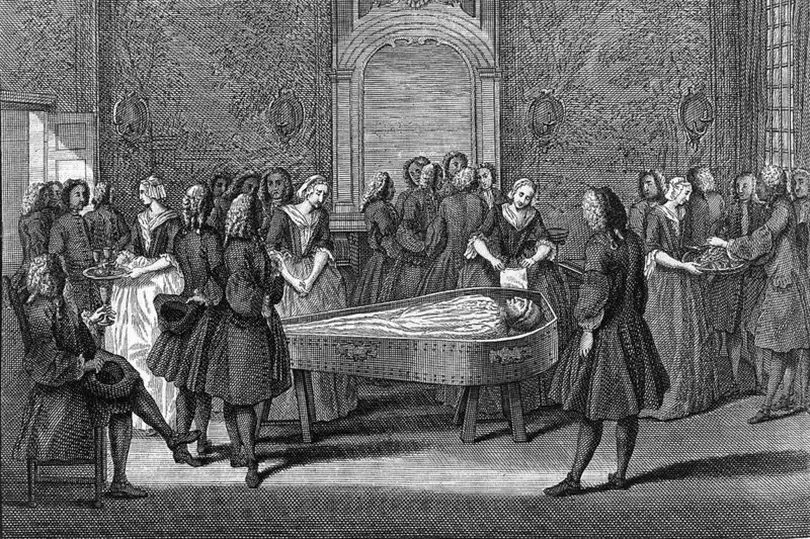
Public science displays aside, many wealthy individuals, keen to hop on the latest trend, were said to have obtained their own mummies and invited their friends over to soirees to dine, drink, and dissect. As these upper class parties often involved copious amounts of alcohol, they could end up quite raucous. Often artifacts, wrappings, and even body parts would be tossed around amongst the curious guests.
Such parties were almost always purely for the entertainment of upper class society and little regard was paid either to respect for the dead, or preserving archaeological artifacts.
It’s worth noting, though, that I couldn’t find any first hand accounts of wild private parties, and some argue that they are an urban myth.10 That’s not to say that mummy unwrapping events in private houses did not happen, but they were probably a lot less boisterous.
One example was held by Lord Londesborough. In 1850, he invited a large party of friends to his Piccadilly residence to witness the unrolling of a Theban mummy, presented to him by a Mr Arden. He even went as far as to print lavish invitations to the event, and it was widely reported in the press. 11,12 This was quite a staid and academic affair by all accounts, so perhaps the boozy antics of private parties were somewhat exaggerated.

A Paying Audience
As contemporary newspaper articles show, there was a public fascination with mummy unrolling. This provided an opportunity to monetize the events by rolling them out to a wider, paying audience. Pettigrew himself had not been above benefiting from the popularity of the Charing Cross and Royal Society events, using them to garner a wide subscription to his book The History of Egyptian Mummies, (1834). By 1836, he had been sacked from the Charing Cross Hospital, due to allegations of corruption, and he saw public mummy unrolling as a new income stream. He advertised a series of public lectures on Mummies at Exeter Hall, with the hook that the final lecture would entail the unrolling of a mummy. Unfortunately, when the day came, the specimen proved a particularly tough one as it was covered in asphaltum and the London Courier reported that:
[I]t became a work of absolute labour to Mr Pettigrew and his assistants, by dint of cutting, hammering and chopping, with very strong tools, to remove the impediments which intervened between them and the object they were seeking to expose.13

In the end, he was unable to completely unroll the mummy in the given time and had to promise the crowd that they could return later to view it. Despite this, the lecture series was a great success with between 500-600 men and women attending.
There was no doubt now, mummy unrolling, which had initially been gilded by a veneer of scientific legitimacy, attended by an invited audience with impeccable credentials, had now slipped into the sphere of public entertainment and macabre spectacle for the general public.
The tide of opinion and popular ethics was also turning against these public autopsies, perhaps because of their mass appeal, they began to be viewed as low brow and tawdry. The destructive nature of the process was also being more widely questioned as Egyptology began maturing as a discipline.
One late event that straddled the uneasy divide of public showmanship and scientific Egyptology was carried out by Margaret Murray (1863-1963).

In 1908, Murray led an interdisciplinary team to investigate the mummies of the ‘Two Brothers’ (Khnum-Nakht and Nakht-Ankh) and later published a book of their findings. As part of the investigation, one of the mummies was publicly unwrapped in the Chemistry Theatre of the University of Manchester. This event was a world away from boozy private mummy unrolling parties, or Pettigrew’s efforts at public science. However, even Murray, who had the distinction to be the first woman to unroll a mummy, was not immune to criticism. By the beginning of the twentieth century public mummy unrolling was often seen as both morbid and destructive.14,15
Conclusion
At their best, public Mummy unrolling events began as an attempt to test ancient sources, understand ancient mummification techniques, and even validate modern hieroglyphic translation systems. Nevertheless, the actual scientific findings from these mummy autopsies were limited by the technologies available at the time. Modern non-invasive techniques can discover much more about the pathology of mummies and historical mummification processes.
At their worst, they were culturally insensitive and materially destructive. Designed for social ‘clout’ rather than to increase knowledge of ancient Egypt.

Thomas Rowlandson, CC0, via Wikimedia Commons
It is also impossible not to view the wholesale ransacking of ancient Egypt’s archaeological past through a post-colonial lens. Nineteenth-century Europeans had a proven track record for ‘othering’ non-European societies. Often exoticizing their material culture and viewing it as primitive or as evidence of barbarity, without considering the cultural context of artifacts. The impact of European collectors on other cultures cannot be underestimated, supply and demand created a market for the desecrated corpses of contemporary Egyptians, stolen from their graves and tricked up as ancient mummies, in a similar way that collectors in the Amazon drove the production and trade in Tsantas (shrunken heads).
Finally, there is the consideration of respect for the dead. Mummies are, at root, former human beings who held specific beliefs about the afterlife. Ancient Egypt had an elaborate religion and sophisticated concept of death and what came afterwards. The highly ritualized mummification process was intended to protect the deceased in their journey through eternity. Museums today often grapple with the dilemma of displaying human remains, is it entertainment or education? How would the deceased feel if they knew they would end up unwrapped and behind glass in a museum, being gawped at by tourists? Perhaps that is why the idea of the mummy’s curse is so popular.
I don’t know what is the answer to this dilemma? Personally, I enjoy visiting mummy displays in museums. Looking into the face of the long dead can be a profound meditation on human existence and fragility. But what do you think, were mummy parties a bad thing? And should mummies still be on display in our museums?

Biography and further reading
Aitchison, Katherine, Unrolling Egypt’s ancient dead, on 4 April 2012
https://blogs.ucl.ac.uk/events/2012/04/04/unrolling-egypts-ancient-dead/
David, Professor Rosalie, Margaret Murray’s Pioneering Investigation in 1908 – The Past (the-past.com) April 10, 2023
Linda Hall Library, The Napoleonic Invasion of Egypt
Literary Review and Dublin Evening Mail, 10th of June 1850, British Newspaper Archives
London Courier and Evening Gazette, 13th April 1837, British Newspaper Archives
London Evening Standard, 8th of April 1833, British Newspaper Archives
Mingren, Wu, Disrespect and Desecration at Victorian Mummy Unwrapping Parties. dated 30 May 2018
Moshenska, Gabriel, Unrolling Egyptian Mummies in Nineteenth-Century Britain. The British Journal for the History of Science, available on CJO 2013 doi 10.1017/0007087413423 https://www.cambridge.org/core/journals/british-journal-for-the-history-of-science/article/abs/unrolling-egyptian-mummies-in-nineteenthcentury-britain/56BF3B3408D2E13EB839FFD58CF738B4
Richardson, Ruth, Death, 2001, Dissection and the Destitute, University of Chicago Press
Selzer, Adam, Smart Aleck’s Guides: Subversive Study Aids: Victorian “Mummy Unwrapping Parties:” Fact or Fiction? (smartalecksguide.com)
Notes
- Gabriel Moshenska, Unrolling Egyptian Mummies in Nineteenth-Century Britain
- ibid
- Katherine Aitchison, Unrolling Egypt’s ancient dead
- Gabriel Moshenska, Unrolling Egyptian Mummies in Nineteenth-Century Britain
- Ruth Richardson, Death, 2001, Dissection and the Destitute
- London Evening Standard, 8th of April 1833
- Gabriel Moshenska, Unrolling Egyptian Mummies in Nineteenth-Century Britain
- ibid
- ibid
- Adam Selzer, Smart Aleck’s Guides: Subversive Study Aids: Victorian ‘Mummy Unwrapping Parties’: Fact or Fiction? < /li >
- Literary Review, 10th of June 1850
- Dublin Evening Mail, 10th of June 1850
- London Courier and Evening Gazette, 13th April 1837
- Professor Rosalie David, Margaret Murray’s Pioneering Investigation in 1908





Leave a Reply